
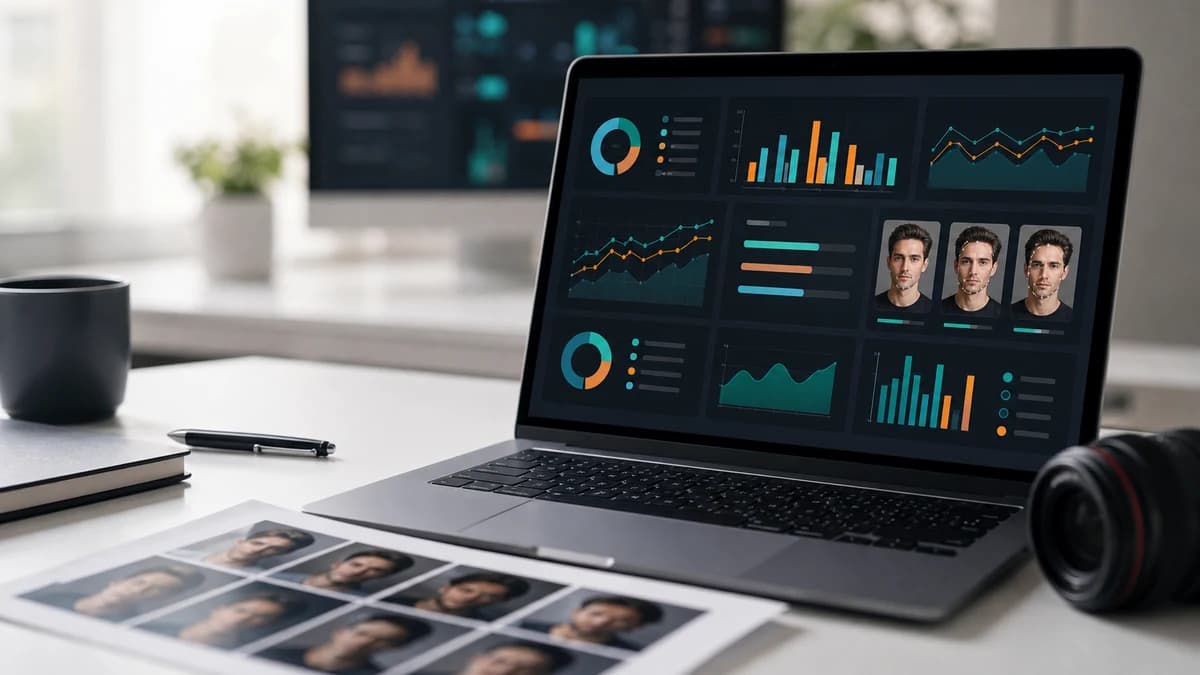
What people mean by the most accurate AI age guesser
Most people do not need lab-grade precision. They want an AI age guesser that gives a believable answer, works quickly, and does not swing wildly between similar photos.
That is an important distinction. A public face age app is usually estimating how old you look in a specific photo, not proving your real age. The best tool is the one that stays stable, explains the result clearly, and avoids exaggerated claims.
Why exact accuracy is hard in face age tools
Apparent age is not the same as birthday age. People can look older or younger than their actual age depending on sleep, expression, skin texture, photo quality, lighting, and styling. That makes exact age prediction difficult even for humans.
AI models also depend on training data. If the dataset is uneven across age groups, skin tones, or photo styles, performance may shift across users and photo conditions.
What usually makes a face age app look inaccurate
A face age app often looks inaccurate because the uploaded image is doing too much damage. Harsh shadows can deepen under-eye lines. A low camera angle can distort face proportions. Blur, heavy smoothing, beauty filters, and social media compression can all remove or exaggerate age cues.
This is why one surprising result should not be treated as proof that the system is bad. First test a cleaner image, then compare whether the result becomes more stable.
How to compare age guessers more fairly
If you want to compare tools, do not feed each one a different photo. Use the same recent portrait, then repeat with two or three other clear photos. That lets you compare consistency instead of luck.
The most accurate face age app usually gets the basics right before anything else. It detects a single visible face reliably, returns a result quickly, handles errors in plain language, and makes it easy to retry with a better image.
- Test the same photo across multiple tools.
- Then test multiple photos on the same tool.
- Watch for wild swings from small image changes.
- Prefer tools that explain limits instead of overpromising.
What accuracy should not be confused with
Accuracy is not proof that a tool understands your health, genetics, or private life. It does not mean it can tell if you are aging well or badly. It only means the predicted number is closer to the label or benchmark used in testing.
For everyday use, the most practical standard is simple: does the tool produce stable, understandable results on clean photos?
Try the AI age guesserUpload a clear photo and compare how different portraits change your apparent age estimate.Quick answers
Can AI guess my exact age?
Not reliably. Most tools estimate apparent age from the photo rather than your exact birth age.
Why does the result change between photos?
Because different photos change the visible age cues the AI uses.
How can I test age guesser accuracy better?
Use clear, recent, minimally edited photos and compare more than one image.
Can I use AI age tools for verification?
No. Consumer age guessers are not formal age verification systems.
What matters more, exact age or consistency?
For apparent age tools, consistency across clean photos is often more useful than one exact result.
Should I trust a filtered photo result?
Not too much. Filters can distort the visual cues that the model depends on.